
What's new
The release notes of Entropy Data
Upcoming
- Data Products: The icon field on the data product edit form is now a searchable icon picker — browse and filter icons by name, each shown with its image — instead of a plain dropdown.
- Customization: The data contract editor's schema property description and examples fields now honor
title,description(rendered as help text below the field), andrequiredoverrides, in addition tohidden. Where no override is set, the built-in label/help for the requested language is used. See the Data Contract Editor Customization documentation. - Customization: A custom section in the data contract editor is now automatically hidden when all of its custom properties are hidden — no more empty section header. A section with any visible (or required) property still renders.
- Customization: The data contract editor's schema physical type field now respects a customized
enumallowlist (previously the override was ignored). - Customization: The data contract editor's team tags field can now be hidden — set
hidden: trueon thetagsstandard property underdataContract.team. Mirrors the existing teamname/descriptionhiding. See Customizations. - Customization: The output port description and tags fields can now be hidden individually via organization customization — set
hidden: trueon thedescriptionortagsstandard property underdataProduct.outputPorts. Both are hidden on the output port edit form and its details view. See Customizations. - Customization: The support-channel tool selector can now be restricted or hidden. Configure an
enumallowlist (with optionallabeloverrides) on thetoolstandard property underdataProduct.supportto limit which tools are offered, orhidden: trueto hide the selector entirely. The dropdown also gained a None option to clear the (optional) tool. See Customizations. - Fixed: Git Integration: Long YAML lines in the conflict resolution editor now wrap within the pane instead of overflowing horizontally.
2.0.12 (2026-06-30)
- Data Products: ODPS data products can now declare input ports in the
inputPortsarray. Declared input ports appear as cards on the data product detail page alongside access-request-derived ports, showing contract schema, source technology icon, and custom properties. Input ports are also visible on linked data contract detail pages. Read more in Input Ports. - Data Products: Output port cards now show a separate badge for data products consuming the contract via an input port, alongside the access-agreement consumer count. Output ports are no longer marked "unused" when an input port consumes their data contract.
- Data Map: When a data product's input port consumes the same data contract that another product's output port exposes, a provider → consumer edge is now drawn in the data mesh graph, rendered identically to access-agreement edges. Self-consumption and pairs already covered by an access agreement are excluded.
- Data Map: "Add Data Product" buttons are now hidden in the marketplace view, consistent with other data product list pages.
- Data Contract Editor: Authoritative definition links now resolve via a single batched request instead of one request per link, significantly reducing editor load time for schemas with many semantic references.
- Data Contracts: ODCS data contracts now validate that all server names within a contract are unique; submitting a contract with duplicate server names returns a clear validation error.
- Platform: The Azure Marketplace SaaS subscription integration has been removed. Azure SSO authentication is unaffected.
- MCP: A new
dataproduct_saveMCP tool lets AI agents create or update a data product from a DPS or ODPS YAML specification. (Experimental) - MCP: A new
dataproduct_schemaMCP tool returns the JSON Schema for data products — DPS or ODPS, including any organization-specific custom schemas — so AI agents can validate or generate data product YAML. (Experimental) - Insights: The Users insights page now includes a language breakdown showing how users are distributed across the available interface languages.
- Customization: Team tags are now hidden by default on all team pages (list, detail, filters, edit). Organizations can surface them by setting
teams.tags.hidden: falsein their customization YAML. - API: Custom team roles and the role mode are now managed through a single aggregate endpoint —
GET /api/settings/team-rolesandPUT /api/settings/team-roles— which carries both the mode (defaultorcustom-team-roles) and the role catalog in one resource. The previous/api/organization/custom-team-rolesendpoints have been removed. - Fixed: AI: OpenAI-compatible AI provider endpoint URLs (Ollama, LocalAI, and similar) are now automatically normalized to include the
/v1path segment when missing, restoring chat, suggestions, and connection tests that were returning 404 errors. - Fixed: Data Map: Filtering the graph — for example by searching for a data product by name — now keeps the matched products' connected sources and sinks visible, instead of showing them stripped of their data flow.
- Fixed: API: Concurrent writes that hit an optimistic locking conflict now return 409 Conflict with a retry hint instead of 500 Internal Server Error.
- Fixed: API: Creating an access agreement with an external id that already exists is now idempotent — duplicate or concurrent requests return the existing agreement or a 409 Conflict instead of a 500 error.
- Fixed: Azure SSO: Static assets such as the favicon are no longer blocked by the Azure SSO authentication filter, preventing spurious OAuth2 500 errors on Azure SSO deployments.
- Fixed: The "resend verification email" and "resend member invitation" actions now correctly honor their 5-minute cooldown — showing a disabled button with a tooltip instead of a misleading success message — and the profile resend button no longer disrupts the page layout.
- Fixed: Saving a data product or data contract spec that only reorders fields no longer records a spurious update in the audit trail or emits update events.
2.0.11 (2026-06-25)
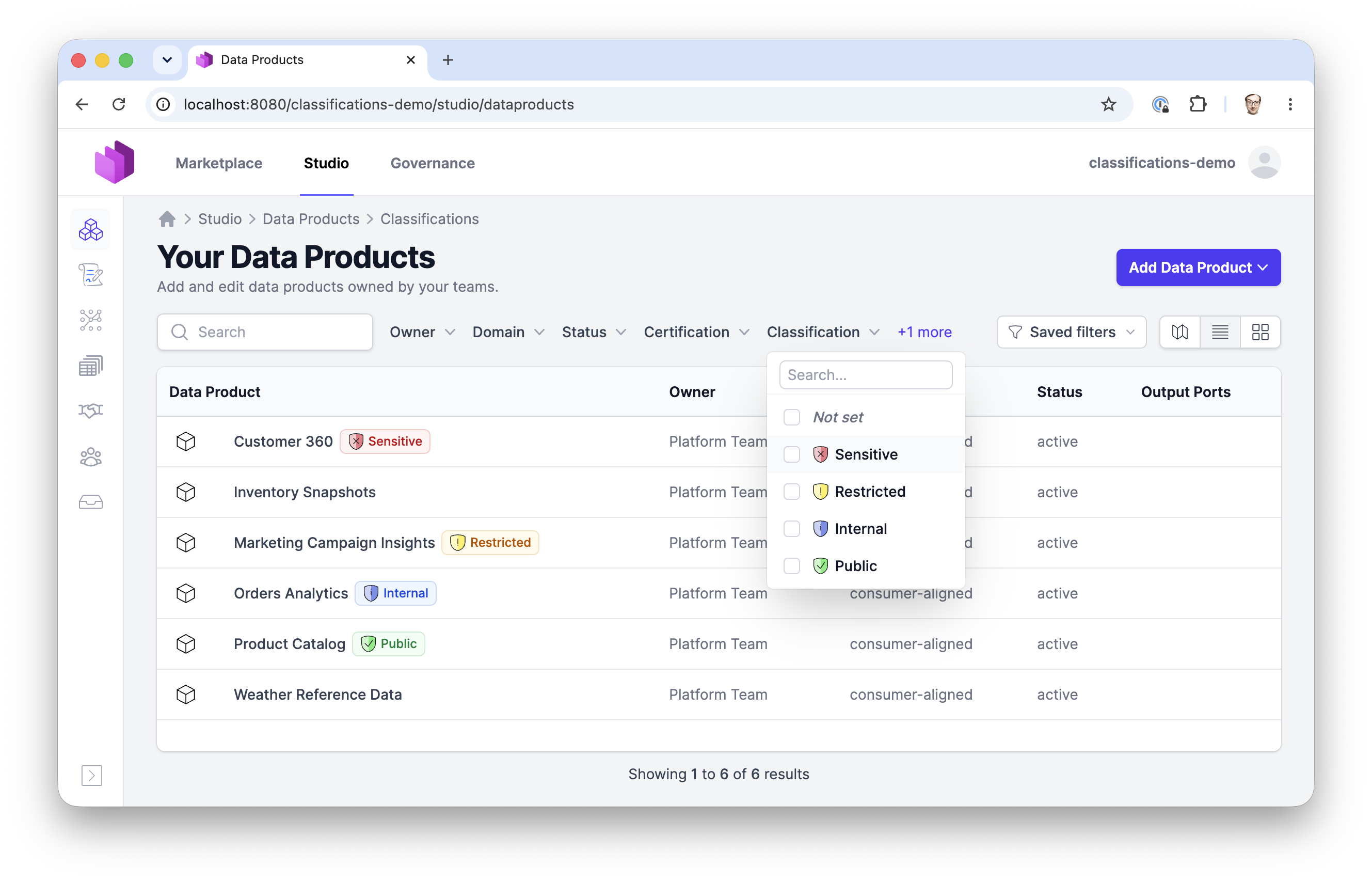
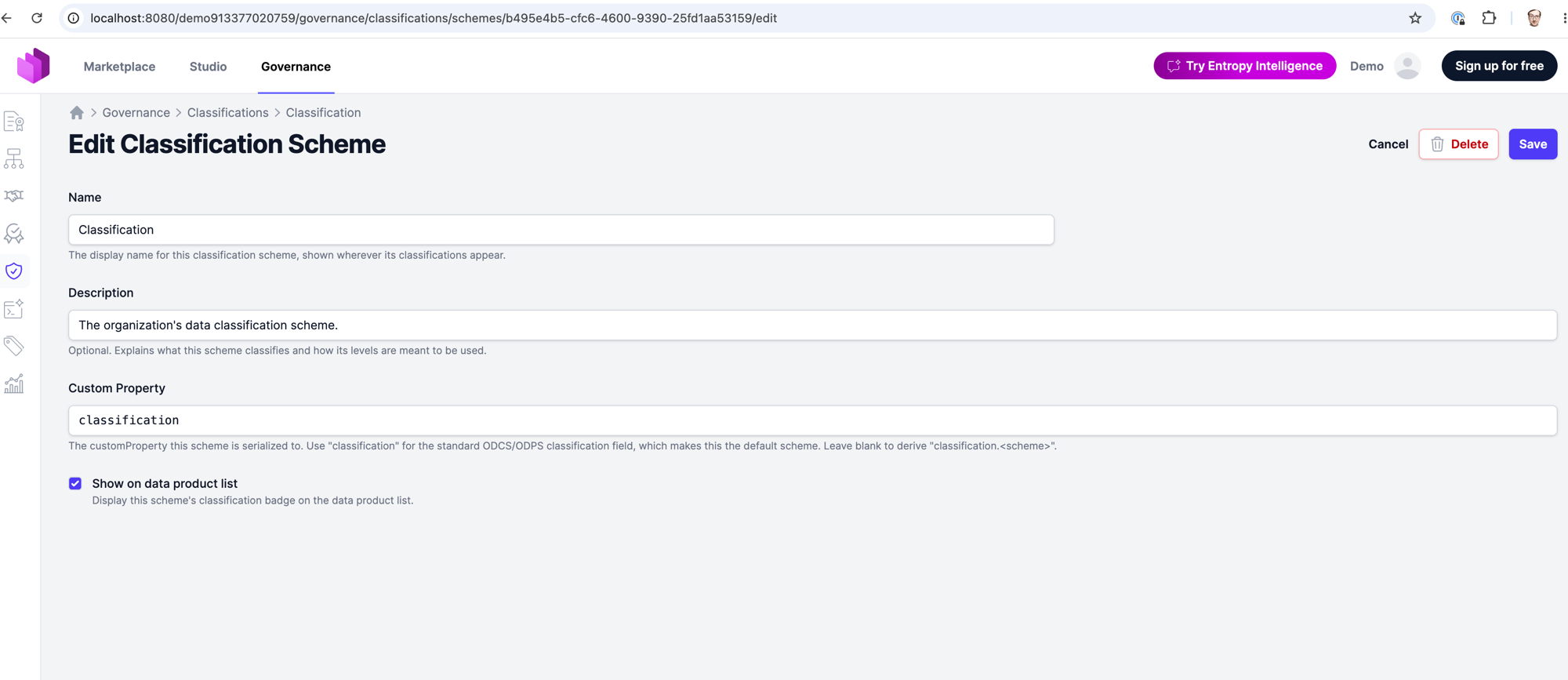
Data Classifications. Organizations can now define classification schemes — such as Data Sensitivity — with configurable tiers (e.g., Public, Internal, Confidential, Restricted). Data products, data contracts (ODCS columns), and semantic concepts can be classified, and badges appear on data product lists, cards, and detail pages with tooltips explaining whether the level was set manually or derived from linked contracts or concepts. Per-scheme filters are available on the data products list, and classification schemes are manageable via the REST API. Read more in Classifications.
German language support. Entropy Data is now available in German. Each user can choose their preferred language in their profile settings, and the entire interface — along with transactional emails and channel notifications — follows that choice. English remains the default, and organizations can set a default language that seeds new members. Self-hosted deployments control which languages are offered and which is the default via application.i18n.supported-locales (env APPLICATION_I18N_SUPPORTED_LOCALES=en,de) and application.i18n.default-locale (env APPLICATION_I18N_DEFAULT_LOCALE=en); the language picker stays hidden while only one locale is enabled.
- Data Contracts: When an organization restricts the allowed values of a standard data contract field — such as limiting
statusto a defined set of values — that restriction is now enforced in the data contract editor's YAML view and on save, not just in the form view's dropdown. Out-of-range values are flagged live in the editor and rejected on save with a clear message, while the underlying open standard schema is left untouched. - Data Contracts: Custom property descriptions on ODCS data contracts and ODPS data products are now shown in a hover tooltip, so longer explanations are available on demand without cluttering the detail pages.
- Navigation: The Studio can now be hidden from the main navigation per deployment by setting
application.studio.enabled: false(envAPPLICATION_STUDIO_ENABLED=false) — useful when a tenant manages its data products and contracts entirely via the API. The Studio nav entry and all "Open in Studio" buttons are hidden when disabled. - Assets: Asset schema pages now include a "Technical details" toggle that shows physical column names and types alongside the logical view.
- Assets: Integration setup links in the assets list are now restricted to organization owners.
- Assets: The assets list page now loads significantly faster for large datasets, with filter options computed more efficiently.
- Teams: The member avatar row on team detail pages now caps at 10 avatars; additional members are indicated with a "+N" count badge.
- Git Integration: Organizations can now configure a custom commit author name and email for all Git operations in Organization Settings → Git — useful when commits should appear under a service account identity rather than the triggering user's credentials.
- Integrations: A native Trino ingestion provider is now available — it discovers catalogs, schemas, and tables directly over Trino's REST statement protocol, so you can catalog Trino-governed data without a separate connector.
- Access Management: API keys can now be given an expiration date when created, so programmatic access can be time-boxed and expires automatically without manual cleanup.
- Privacy: Email addresses and user names are no longer included in HTTP request/response logs or observability telemetry.
- Fixed: A misconfigured or broken Git connection on a data contract no longer prevents the detail page from loading; an unrecognized connector type now produces no link instead of a crash.
- Fixed: The sort dropdown and "Add Data Product Builder" menu no longer get clipped behind sticky table headers.
- Fixed: The ODCS data contract schema view no longer crashes with an error when a classification scheme field contains a null value.
- Fixed: Data products with a legacy custom icon value no longer show a broken image; the archetype default icon is used as a fallback.
- Fixed: The Organization Insights page no longer crashes when displaying drilldown panels.
- Fixed: Access approvals now complete correctly even when email notifications fail due to a misconfigured mail server; previously a mail configuration issue could leave an access agreement in an approved-but-inactive state.
- Fixed: Snowflake External OAuth settings pages no longer throw a template error for organization owners.
- Fixed: Assigning or removing an asset on an ODPS data product no longer clears previously assigned assets of the same type; the fix corrects a deserialization issue that caused existing assets to be silently dropped.
- Fixed: Navigating to assign, edit, or unassign assets now returns you to the studio or governance context you came from, instead of always redirecting to the marketplace.
- Fixed: ODCS specifications containing null elements inside collection fields (such as
exampleslists) are now accepted and the null entries are skipped, instead of failing with a parse error. - Fixed: Assets with very long descriptions can now be saved; previously descriptions beyond a certain length failed to save.
- Fixed: Asset search no longer crashes when an asset contains invalid control characters in custom fields ingested from binary sources such as Parquet or zip column statistics.
2.0.10 (2026-06-17)
- Power BI: "Publish to Power BI" has been redesigned as a multi-step wizard — connect a Power BI workspace, choose publish options with connections pre-filtered to compatible technologies, preview the semantic model structure, and track publish progress, all within a guided dialog.
- Entropy Intelligence: Data contract and access agreement badges in the inspector panel are now clickable links that open the related resource in a new window.
- Organization Settings: The Roles & Permissions settings page now supports per-role editing for custom team roles — click any custom role in the matrix to edit its individual permissions. Switching between default and custom role modes now requires an explicit confirmation step, with a lockout warning when switching to custom mode without any custom roles defined.
- API: The Integrations API is now keyed on
externalIdinstead of internal UUIDs across all paths; audit fields (createdAt,createdBy,updatedAt,updatedBy) are no longer returned in Integrations and Custom Team Roles API responses; integration configuration is now returned inline on the detail endpoint asapplication/yaml; a newGET /api/integrations/{externalId}/runs/latestendpoint returns the most recent run. The separate/api/integrations/{externalId}/configurationendpoint has been removed. - Fixed: Entropy Intelligence: The chat input is now cleared after retrying a query following an access approval, preventing the previous message from being re-sent unintentionally.
- Fixed: Submitting a scalar value for an output port server property that expects an object now returns a 400 response instead of a 500.
- Power BI: A new "Open in Power BI Workspace" dropdown entry on output ports lets you navigate directly to the matched Power BI workspace in the portal. Connected semantic models are listed and grouped by workspace — with Power BI icons and external-link indicators — and server properties such as
httpPathare pre-filled from the output port's server configuration. - Data Products: The data product editor now shows concept icons next to semantic references and provides a preview sidebar when linking a semantic concept.
- Semantics: The bulk "Suggest semantics for all properties" feature can now be enabled on self-hosted deployments by setting
application.bulksemanticsuggest.enabled: true(envAPPLICATION_BULKSEMANTICSUGGEST_ENABLED=true). - Fixed: Entropy Intelligence: The access check badge in the inspector panel now deep-links directly to the specific matched access agreement.
- Fixed: Teams: The Status column in the data products table no longer gets clipped.
2.0.9 (2026-06-15)
- Marketplace: Domain and data product carousels now use arrow-button paging instead of a scrollbar, snapping to card boundaries.
- List Views: Sticky table headers and content-aware scroll panels now apply to many more list views — including domains, teams, assets, certifications, policies, semantics, tags, and access agreements — so long tables scroll within their panel while short ones shrink to fit instead of leaving empty space.
- List Views: Table rows across the application are more compact. Tags on list items now display the first two tags with a "+N" badge for any additional tags, keeping rows to a single line.
- Filters: List filter dropdowns now stay open while you type or toggle options, instead of snapping shut on each change.
- Filters: The data products list gains a Certification filter and a "Not set" option on Owner, Domain, Status, Type, and custom field dropdowns that matches data products where the field is unset. A shortcut on the Certifications governance page links directly to uncertified data products.
- Filters: The Consumers list filter dropdowns (provider data product, consumer, and status) now pre-filter to only show options that would yield results given the other active filters — matching the behavior introduced for the data products list. A "Show all" toggle reveals the full option set.
- Data Products: The "Add Data Product" form now auto-suggests an ID derived from the name you type — the derived slug is editable, automatically satisfies the organization's configured ID pattern, and the pattern is enforced server-side as well.
- Data Contracts: When linking a data contract to a data product, you can now create a new data product on the spot — with a changeable owning team — instead of only picking an existing one.
- Data Contracts: Adding a new field in the embedded data contract editor now pre-fills configured property defaults.
- Data Contracts: When ODCS is the supported specification format, the deprecated Web UI and YAML edit and add options are now hidden from the Add Data Contract dropdown and the ODCS details page options menu, keeping only the relevant actions visible.
- Semantics: Semantic reference links in the data contract visualizer now show the semantics icon, making them visually distinct from plain reference links.
- Certifications: The certifications governance page now shows a Coverage column with the percentage of all data products that hold each certification tier.
- Entropy Intelligence: SQL queries via MCP now time out gracefully across all supported warehouse types (Snowflake, BigQuery, Databricks, Postgres, Trino, Redshift, MySQL, MariaDB, MSSQL) — connect timeout 10 s, query timeout 40 s — so a slow or hung warehouse no longer blocks the MCP connection indefinitely.
- Visualizers: All graph visualizers — semantic graph, OpenLineage, data contract, data map, and ODCS editor — now share a unified toolbar with consistent zoom, fit-view, and layout/collapse controls and icons.
- Organization Settings: The organization settings sidebar navigation is now grouped into labeled sections — General, Access & Security, Governance & Workflows, and AI — making it easier to find the right settings page.
- Organization Settings: The Roles & Permissions settings page now groups permissions by category and shows a read-only matrix of the five built-in roles (Owner, Approver, Editor, Member, Steward) against all permissions for a quick at-a-glance review. Selecting a role type (Default vs Custom) collapses the unselected section to reduce scrolling.
- Git Integration: Changing or pulling a data product's git connection now requires edit permission, matching the REST API; these actions are hidden from users without edit access.
- Git Integration: Deleting a data product now also removes its git connection, so you can immediately create a new product against the same repository, branch, and path.
- Integrations: Microsoft Fabric: Several fixes to OneLake asset imports — Eventhouse items are no longer incorrectly traversed as OneLake folders; KQL database tables link to the correct Fabric portal page; Warehouse tables include the SQL Server port (1433); all OneLake table types now emit ODCS servers with connection details so the generated data contract is immediately queryable.
- Teams: Deleting a team is now blocked when it has child teams, preventing the children from being orphaned.
- Data Product Builders: Builders can now be restricted to specific server technologies (e.g. Snowflake, BigQuery, S3). A builder with server types configured is only shown for data products whose output ports or bound data contracts use a matching server technology.
- Access Agreements: The team picker in the Request Access and Add Access forms is now hierarchical — teams are shown with type badges and their parent path, making same-named teams across different org units distinguishable.
- Customization: The output port environment, version, and server sections can now be hidden individually via organization customization — set
hidden: trueon theenvironment,version, orserverstandard property underdataProduct.outputPorts.standardProperties. Useful when those fields are managed in the linked data contract and the duplicate display adds clutter. - Custom Properties: Custom property sections on data product, data contract, output port, and access agreement detail pages now display as description-list cards — label above value — instead of name/value tables, for a cleaner and more consistent look.
- API: New REST API for managing custom team roles at
/api/organization/custom-team-roles— list all roles, fetch by name, create or update in place (PUT), and delete. Deleting or renaming a role that is still assigned to team members returns 409 Conflict; the settings UI now surfaces the same error instead of silently orphaning the assignments. - Fixed: Clearing the domain field in the data contract editor now saves correctly; previously the previous value persisted.
- Fixed: The Member role description shown on Governance Group team-member forms now reads "Can edit governance resources, such as policies and certifications" instead of the misleading "Cannot edit resources."
- Fixed: Team-level git credentials now appear in the data-product and data-contract import forms; previously only organization-wide and personal credentials were offered in the dropdown.
- Fixed: Markdown now renders correctly in long-form text fields across the application — including output port descriptions and cards, input port descriptions on data product detail pages, team descriptions, data usage agreement purpose and rejection reason, and contract terms (usage, limitations, billing). Previously these fields displayed raw markdown source.
- Fixed: Data Products: Editing an input port no longer overwrites the port's external ID with its source system's ID; previously, when the two IDs differed, saving the port caused a crash.
- Fixed: Policies: The "Change Status" modal on a new unsaved policy no longer becomes unresponsive when the policy name field is empty.
- Fixed: Access Agreements: Access Agreement details (purpose, consumer identity, rejection reason) are now restricted to involved parties — the provider team, consumer team, organization owners, and governance group members. Previously any organization member could view all access agreements.
- Fixed: MCP: MCP sessions no longer produce errors when a client reconnects after a sleep/wake cycle or network interruption.
2.0.8 (2026-06-05)
- Excel Import: Importing a data contract from Excel now enforces the organization's managed-tags policy, so organizations that require managed tags can no longer introduce unmanaged tags through an import. Property names that contain literal dots (e.g.
No. of sites) in hand-authored sheets are preserved instead of being silently dropped, and contract- and schema-level tags are trimmed on import. - API: The ODCS semantics and single-definition endpoints now accept API-key authentication, so programmatic callers such as the datacontract CLI can resolve semantic concepts and definitions with an API token. A new
GET /api/semantics?iri=…resolves a concept by its stable IRI. The OpenAPI spec now documents the RFC 7807application/problem+jsonerror format used by all/api/**responses, includingProblemDetailandValidationProblemDetailschemas, so consumers know the explanatory message lives at$.detail. - Semantics: Opening a semantic concept URL in a browser now serves the concept browser page instead of raw JSON;
odcs+jsonand API-key requests still receive the JSON definition. - Power BI: "Publish to Power BI" is no longer gated behind a global feature flag — availability is now determined solely by each organization's Power BI settings.
- Privacy: Deleting a user — via the SCIM
DELETE /api/scim/v2/Users/{userId}endpoint or admin user deletion — now erases all of the user's personal data along with the account: AI assistant conversations, summaries and chat logs, search history, saved filters, data contract watches, user-scoped API keys, in-progress Microsoft Fabric / Power BI OAuth flows, git credentials, data source connections, uploaded profile picture (avatar) images, user settings, password-reset and email-verification tokens, active sessions, and MCP authorizations and consents, in addition to organization and team memberships. Audit fields and activity history are retained for traceability. See GDPR Deletion. - Insights: The Assets Insights breakdown now shows source and type logos, making it easier to identify asset categories at a glance.
- Navigation: Breadcrumbs have been added to the Intelligence, Export, MCP Clients, SCIM, and Schemas settings pages for easier navigation.
- MCP: New
dataproduct_savetool to create or update a data product from a YAML specification (DPS or ODPS). (Experimental) - MCP: New
dataproduct_schematool to retrieve the JSON Schema for data products (DPS or ODPS), including organization-specific custom schemas. (Experimental) - Git Integration: Bitbucket Cloud repository listing now works correctly using the current workspace API. API Token is the recommended credential type and App Password is marked as deprecated.
- Data Contracts: The data contracts list and cards now show a server count badge with deduplicated technology icons. Hovering over the badge opens an overlay listing each server with its environment badge and connection details.
- Data Contracts: Custom properties are no longer shown on schema badges to eliminate redundancy and duplication.
- Certifications: New certification analytics and visualizations are available on the Organization Insights page.
- Data Products: Users with an active Data Usage Agreement (DUA) can now view restricted or private data product detail pages. Previously an active DUA was visible in the access overview but navigating to the product returned a 403.
- Entropy Intelligence: Read-only query validation now also accepts
WITH,DESCRIBE,SHOW, andEXPLAINstatements in addition toSELECT. - Integrations: Informatica is now listed as a coming-soon integration.
- Semantics: Importing an ontology into an unregistered namespace now automatically registers the namespace, so imported concepts are immediately reachable in the namespace-scoped Studio UI.
- Admin: The organizations admin table now displays host and brand columns for easier identification.
- Fixed: OneLake icon no longer disappears when a Power BI icon is displayed on the same page.
- Integrations: Microsoft Fabric OneLake tables and files are now discoverable through the Fabric integration. OneLake tables appear in the asset tree with their Delta Lake column schemas, so creating a data product from a OneLake table pre-populates the data contract with the table's columns automatically. Lakehouses, Warehouses, and SQL endpoints are also supported. The Import-from-Asset wizard correctly sets the output port type for each Fabric asset type.
- Data Contracts: The data contract visualizer now supports exporting the diagram as a high-resolution image, including a full-graph view at native zoom.
- Customization: Organizations can now restrict which server types appear in output port and data contract server dropdowns by configuring an allowlist on the
typeproperty'senumin the customization schema. Each enum option supports an optionallabelto override the display text while preserving the stored value. Server types already in use are always preserved. - Semantics: The "Convert to Semantic" confirmation modal now explains the type mapping — object definitions become Entities, all others become Shared Properties — and notes that the conversion cannot be undone.
2.0.7 (2026-05-21)
- Data Product Builders (experimental): A new opt-in feature that guides you — and your coding agents — through building a data product from its contract. Each builder ships Markdown usage instructions; the dbt builder additionally bootstraps a project from an ODPS draft and exposes a reload command. Usage instructions can now vary by data product status, with a generic fallback when no status-specific block matches. dbt and Snowflake builders are available, while Databricks and AWS Glue appear as "Coming soon". Enable with
application.dataproductbuilder.enabled. - Data Product Builders: Usage instruction cards gained a one-click copy button for code snippets and an
entropy-data connection testline in the authentication step, plus a Feedback section linking to the builder plugin repository. The install/update cards on the agent setup page have been consolidated, and the API-key-created info box is aligned with the builder layout. - Semantics: New bulk "Suggest semantics for all properties" for data contracts. An async job analyses an entire ODCS contract, proposes one best concept per unlinked property, and applies the selected suggestions in a single save (one version bump and audit entry). A progress poller and a dedicated review screen, grouped by schema, drive the workflow.
- Semantics:
authoritativeDefinitionURLs that don't match the/semantics/{ns}/{id}path pattern (custom IRI schemes, e.g.http://host/ns/main/Article) now resolve by the stored IRI as a fallback, so the link is preserved instead of dropped. Semantic link buttons resolve by IRI even when the host is internal. - Power BI: Semantic-model details now render a dedicated "Tables" section that mirrors the data contract schema view, with column-level relationships between tables. Columns and relationships are enriched from upstream input-port data contracts so descriptions, types, semantics, and foreign-key links carry over, and data contracts generated from a semantic model inherit those column definitions on 1:1 matches and promote table relationships onto the contract's column
relationshipsinstead of leaving them as an opaque custom-properties blob. The Import-from-Asset wizard preview now shows the full lineage chain — source data product → semantic model → report — when launched from the matched-Power-BI banner, and the marketplace view hides Power BI import banners. - Data Products: Creating a data contract from the type-selection flow now connects the contract to the selected output port and no longer overwrites an output port that already has a contract bound to it.
- Data Contracts: The Data Quality card has moved above Support on the ODCS details page. The embedded data contract editor bundle has been refreshed with a semantic-link icon and inherited-type rendering in the diagram view.
- Import/Export: Governance policies are now included in the organization export zip (
policies/) and restored by theentropy-data import zipcommand.
2.0.6 (2026-05-13)
- API: New policies REST API (experimental) with GET/PUT/DELETE endpoints under
/api/policiesfor managing governance policies through API tokens, documented in the OpenAPI spec. - Git Integration: Pushing newly created files now succeeds on the first push for both data products and data contracts, instead of failing when the path does not yet exist. Pulling no longer silently drops a rename — a contract or product whose externalId was changed in Git is now looked up by UUID first, falling back to externalId on Import, and whitespace in YAML IDs is normalized before lookup. Error messages on Git operations are clearer.
- Marketplace: AI search now reranks results before truncating to the top 10, so exact name matches are no longer dropped by Postgres
ts_rankordering when many products share similar terms. - Data Products: ODPS input port saves with invalid data now surface inline validation errors instead of a generic error page.
- Integrations: Removing a Snowflake External OAuth configuration now works correctly from the configuration form.
- List Views: Filter dropdowns in data product and data contract tables no longer get clipped behind the sticky table header.
2.0.5 (2026-05-11)
- Multi-organization: Users who belong to multiple organizations now land on a new organization-chooser screen after login when no default is set, and the header gains an organization switcher dropdown that makes the active org clear and easy to switch. The default-organization flag is now toggled only by explicit Make Default / Unset Default actions, and never set automatically by SCIM provisioning or SSO auto-join.
- Data Products: Quick-create forms (data product, application, data consumer, AI agent) now expose an ID field so the externalId can be chosen at creation. The YAML editor opens with an editable
example-id # change meplaceholder rather than a pre-generated UUID, so the ID is chosen deliberately. Organizations that prefer auto-generated UUIDs can opt back in by settinggenerationStrategy: uuidon theidstandard property. - Data Products: "Add Source System Input Port" works again for ODPS data products, with the post-save redirect now resolving to the persisted UUID. Saving a data product with an invalid externalId is blocked at the API with a 422 and shown inline in the form instead of an error page.
- Data Products: The output port editor now guides users toward picking an existing data contract server when one is available, with an inline warning below the server select.
- Git Integration: New conflict-resolution wizard replaces the old single-form conflict screen. Step 1 shows local vs. remote YAML side-by-side using CodeMirror MergeView; step 2 offers a Push Directly / Create PR or MR choice with a dedicated PR/MR form. Conflicts also auto-resolve to "patch synced" when an open patch submission already covers the local changes.
- Intelligence: AI search now reranks results across tools using the same per-card relevance scoring as standard find mode, and honours the active resource-type filter so the LLM no longer queries tools for types that are unticked.
- Marketplace: The marketplace search filter now defaults to Data Products, and Semantic Concept results have received UX polish.
- API: Lineage endpoints (GET/POST/DELETE) now accept team- and user-scoped API tokens with proper per-team read and write scoping. A new endpoint returns organization settings, and the OpenAPI spec documents valid team-member role values.
- Semantics: Data contracts, the concept "Usages" list, and internal Markdown links now resolve hierarchical concept externalIds (e.g.
sales/customer), so grouped concepts inherit descriptions and examples in ODCS schemas again and render as internal Semantic Concept pills. - Data Contracts: Excel export and import handle property names containing dots and unnamed array items correctly instead of round-tripping them as
nullcells. ExternalId normalization is tighter on every save path. - List Views: Data product and data contract tables scroll inside a height-constrained panel with a sticky header row. Filter dropdowns render above the sticky header instead of behind it, and decorative icons in owner/domain/type/status/version columns have been dropped for a cleaner look.
2.0.4 (2026-05-06)
- Integrations: New built-in Microsoft Fabric / Power BI ingestion to import Power BI semantic models and reports as assets. Authentication uses a Microsoft Entra service principal scoped to selected workspaces. The asset tree mirrors
app.powerbi.com(workspace → folder → model/report → table), with reports carrying ausesedge to their semantic model so lineage resolves the dependency. Marked Experimental. - Data Products: Microsoft Fabric is now available in the Import-from-Asset wizard. Power BI semantic models can be imported as Power BI data products with output ports prefilled from the model's tables and columns.
- Data Products: New
ai-agentarchetype for data products that expose AI agents. Mirrors the data-consumer pattern with no output ports and no KPI card, and is excluded from the marketplace. - Assets: Power BI semantic-model assets show a
.pbidsdownload on the details page, so users can open the model directly in Power BI Desktop with the model's storage mode honoured. - Assets: Asset details now include a "Used by" section listing downstream relationships, with type-specific icons in the asset header.
- Navigation: The Assets nav item has moved from Governance to Studio for easier discovery.
- Marketplace: Domain and owner filter dropdowns now show all available values, not just the ones present in the current view.
- Git Integration: Pushing to a Git target branch now creates files on the first push instead of failing when the path does not yet exist.
- Git Integration: Conflict resolution for data products now resolves correctly and renders proper error fragments instead of a generic error page.
- Git Integration: Push and connect actions confirm success with a flash message after HTMX-driven submits, and credential-info updates are scoped to the relevant import page.
- Intelligence: Hardened chat suggestions against prompt injection by stripping sentinel sequences from untrusted metadata before the model sees it.
- Platform: CDN-loaded JavaScript and CSS dependencies have been replaced with local/webjar assets, so the platform runs cleanly in air-gapped installs.
2.0.3 (2026-04-29)
- Marketplace: Card icons are now clickable links matching their titles, for quicker navigation.
- Insights: New User Analytics section on the Organization Insights page, with a user growth chart and membership statistics.
- Insights: Time range filters across the insights pages can now be adjusted dynamically, and data product cards are interactive for drill-down.
- Insights: New Data Product Reuse metrics highlight how often data products are consumed across the organization.
- Governance: New "Servers per Contract" histogram on the Governance Insights page surfaces contracts missing server definitions or with unusually many.
- Power BI: When publishing a semantic model, users can now choose between Import and DirectQuery storage modes from the Open in Power BI dialog.
- Semantics: The visualizer now persists drag positions and toggle state per diagram in browser local storage, so layouts are preserved across reloads.
- Semantics: Translated descriptions now support Markdown, both in the editor (multi-line input) and on the details page (rendered output).
2.0.2 (2026-04-24)
- Integrations: Existing integrations can now be re-configured through the setup wizard. The Edit button is now a dropdown offering either the guided wizard or direct YAML editing, with credential handling that adapts when the authentication method changes.
- Notifications: New Microsoft Graph mail provider for self-hosted M365 tenants where SMTP AUTH is disabled. Configure with
application.mail.provider=graphand an Entra app registration holding theMail.Sendapplication permission. - Data Contracts: Output port IDs are locked once active consumers exist, preventing renames that would break consumers. An inline hint explains the locked state.
- Data Contracts: External IDs are now normalized and validated on every save path. Invalid external IDs are rejected at the API with 422, and form validation shows inline messages instead of an error page.
- Data Contracts: Creating a data contract through the editor API now requires the ADD permission.
- Governance: Data contracts using the DCS specification are now included in the governance insights aggregation.
- Semantics: The visualizer now supports collapse and expand, and renders semantic groups with a visual boundary around their concepts.
- Semantics: Property detail pages show the parent concept and its group. A new Technical Fields group surfaces last-updated and process timestamps.
- Semantics: Concept pages suggest bindable data products, scoped to entity and metric concepts for more relevant matches.
- Integrations: Amazon Redshift is now available in the integration schema, and credential form field keys are aligned with their data-class fields.
- ODCS: Data product team members are restricted to native members, and data product pages now include a support sidebar.
- Saved Filters: Filter scopes can now be set when saving, so the same filter set can be targeted at specific views.
- Fixed: Team and domain filters in the Data Products graph view.
- Fixed: Output port duplication when renaming an existing output port id.
- Fixed: Check run lookups now use the server-based format consistently, with SQL join bugs corrected.
- Fixed: Tooltip rendering in wrapped elements.
- Fixed: Integration secrets and ingestion updates are now strictly scoped to the owning organization.
2.0.1 (2026-04-21)
- Saved Filters: Save and reuse filter combinations on the Data Products list, board, cards, and map. One filter can be marked as default and is applied automatically when no other filters are selected.
- Data Products: The Owner and Domain filters now support picking a parent in the hierarchy. Selecting a parent filters the whole subtree and saves as a single value, so the filter stays valid when teams are added or moved later.
- Entropy Intelligence: New Intelligence Inspector with developer mode, tool-call inspection, semantics context, popovers for data-product references in chat, and a modal showing full SQL query details.
- Entropy Intelligence: Plan management to surface the agent's pre-execution plan before queries are run.
- Governance: New Data Contract Insights card on the Governance Insights page, including an owner filter.
- Data Contracts: Schema display now has a visibility toggle so large schemas can be expanded or collapsed in place.
- Data Products: Image uploads in rich-text fields are validated, rate-limited, and rehosted on the platform.
- Semantics: Properties linked through ODCS
authoritativeDefinitionnow show the semantics icon on the schema label, and bothsemanticandsemanticslink types are recognized. Studio context is preserved when navigating into semantics. - Customization: Custom properties and custom sections support enum anchors in
customization.schema.jsonfor richer dropdown configuration. - Fixed: Validation issues in the Data Contract Editor and missing CSRF header on accepting semantic suggestions.
- Fixed: Disabled integration badges are now styled in red on both the list and details pages for clearer status.
2.0.0 (2026-04-17)
- Semantics: Model your business domain as a shared ontology of concepts and relationships, and link them to data products and data contracts. Define what terms like Order, Customer, or Monthly Recurring Revenue mean across your organization, discover data by meaning rather than table name, and power semantic search and AI-driven querying. Semantics replaces Business Definitions.
- Open in Power BI Support
- Data Contract Editor: Relationship drawing, layout, and table collapse interactions have been polished for clearer edge handling and node-border anchoring.
- Access Management: Access agreement URLs and email notifications now use the external ID instead of internal UUIDs, and agreement changes are displayed as a diff in the audit trail.
- Access Management: Data product visibility is now inherited through team hierarchies, so members of parent teams can see data products owned by descendant teams.
- Access Management: Access agreements can now be deleted even when referenced entities have already been removed.
- Access Management: The "Connect" and "Add Access" flows now respect the
canRequestAccessFromcheck. - Integrations: Snowflake now supports dynamic role selection and resolves the appropriate role from access agreements automatically.
- Integrations: BigQuery ingestion now streams pages instead of loading everything in memory, significantly reducing memory usage on large projects.
- Customization: Output port customizations now support id, name, and description properties.
- Notifications: Email notifications now show the data contract title instead of the technical ID, both in the subject and body.
- Notifications: Quality check and data contract update emails now include a direct unsubscribe link. Clicking it opens a confirmation page where watchers can stop receiving notifications for the contract with a single click, without navigating the app.
- Notifications: Quality check failure emails now include a summary of the failing checks (check name and reason), so recipients can triage without opening the app.
- Entropy Intelligence: Snowflake connections via External OAuth now show role and warehouse as editable badges instead of text inputs. When roles are defined in the access agreement, they are pre-selected automatically.
- Entropy Intelligence: After completing SSO authentication, the query is now automatically retried without requiring manual intervention.
- Entropy Intelligence: Expired Snowflake OAuth tokens now correctly show the SSO login prompt instead of the PAT credentials form.
- Fixed: Output port tags overflowing horizontally instead of wrapping when many tags are assigned.
- Fixed: Various frontend JavaScript errors observed in production.
- Fixed: Customization links with blank hrefs no longer persisted on save.
- Fixed: Links in quality check emails now correctly encode server names that contain spaces or special characters.
- Fixed: Change request rejection emails now use the correct template (previously labelled as approval).
1.9.7 (2026-04-01)
- Data Contracts: Schema-level relationships are now displayed as edges in the data contract visualizer graph.
- Data Contracts: Excel exports now include relationships.
- Customization: Custom properties and custom sections are now supported on output ports, matching the existing data product customization capabilities.
- Git Integration: Git credentials now support an optional external ID for explicit credential selection. When multiple credentials exist for the same provider, a credential dropdown appears in the Git connection form, and the selected credential is remembered for consistent authentication.
- Integrations: PostgreSQL ingestion now captures richer column metadata including descriptions, nullability, and default values.
- Integrations: Snowflake now supports External OAuth as an authentication method with organization-level OAuth settings.
- API: Git import and connection endpoints now accept an optional
gitCredentialExternalIdfor explicit credential targeting. ThegitConnectionTypefield is optional when an external ID is provided.
1.9.6 (2026-03-31)
- AI: Data Contract Editor now supports Anthropic as an AI provider for the inline AI assistant.
- AI: Azure OpenAI endpoint URLs are now automatically normalized to the base URL on save.
- AI: Fixed support for GPT-4o and other non-reasoning models
1.9.5 (2026-03-30)
- Integrations: New built-in Amazon Redshift ingestion to sync databases and tables as assets.
- Integrations: Trino support for querying data via Entropy Intelligence and MCP.
- Integrations: Oracle and Dataiku icon support and asset import.
- Data Contract Tests: New Test Connection button on settings page to verify connectivity before running tests.
- Data Contract Tests: API and MCP tools for running data contract tests programmatically.
- Data Contracts: SLA properties now support description fields for richer metadata.
- Data Contracts: Quality results are now aggregated across all servers on the data contract page.
- Entropy Intelligence: Intelligence card added to data contract detail pages for quick access.
- Entropy Intelligence: Certification badges are now displayed on data product cards in chat results.
- Data Map: The data map is now accessible directly from the marketplace sidebar for easier navigation.
- Navigation: Renamed "Definitions" to "Semantics" in the sidebar.
- Fixed: External ID not being updated when editing data product YAML.
- Fixed: Organization members with no team memberships could see all data contracts in Studio.
- Fixed: Race condition when editing data product YAML by navigating directly.
- Fixed: ODCS server port serialization now correctly uses integer values.
- Fixed: Check run detail links and status badges on data contract pages.
- Fixed: Performance issue with check run summary queries.
1.9.4 (2026-03-20)
- AI: Anthropic Claude models are now available as a Bring Your Own provider. Supports direct Anthropic API and Azure-hosted endpoints.
- Access Management: Access agreements approaching expiration are now highlighted, with the option to renew directly.
- Entropy Intelligence: Improved query result rendering and markdown display.
- Data Products: Support channels are now displayed on data product detail pages with icons for Slack, Teams, Email, Discord, Google Chat, and more.
- Data Products: AI context attributes for improved search and discovery.
- Rich Text Editor: Description fields now support rich text formatting with markdown preview.
- Data Contract Editor: Test URL can now be changed directly in the editor.
- Data Contract Editor: Support for regex validation rules via customizations.
- Integrations: New built-in MariaDB ingestion to sync databases and tables as assets.
- Integrations: New built-in MySQL ingestion to sync databases and tables as assets.
- Integrations: New built-in SQL Server ingestion to sync databases and tables as assets.
- Integrations: AWS Glue ingestion now supports S3 folders as data sources.
- Customization: Customize Access Agreements and Request Access form.
- API: Improved owner field validation with clearer error messages.
- API: Team-level and organization-level Git credentials endpoints.
- API: API key management and data product Git connection endpoints added to OpenAPI spec.
- API: Git connection endpoints now use provider type and host instead of connection name.
- Platform: Upgraded from Java 21 to Java 25.
- Fixed: Excel export crash when a data contract has duplicate schema names.
- Fixed: Doubled commit messages caused by duplicate form fields.
- Fixed: Output port tooltip on the visualizer graph showing null values for missing type or status.
- Fixed: Improved performance for check run queries and chart loading on data contract pages.
1.9.3 (2026-03-09)
- Git Integration: Data products can now be imported from Git repositories.
- Data Products: ODPS team members can now be added and removed directly in the edit form.
- Data Contracts: External IDs are now editable when enabled via feature flag.
- SCIM: Added SCIM mapping API endpoints for configuration management.
- Fixed: Git settings optimistic locking and credential form issues.
- Fixed: Ingestion runs for parallel deployments.
1.9.2 (2026-03-05)
- [Experimental] Lineage: OpenLineage integration for ingesting, viewing, and managing lineage events. Lineage graphs are displayed on data product pages.
- Git Integration: Auto-push for data contracts. Changes to data contracts can now be automatically pushed to Git repositories, with support for conflict detection and configurable push modes at organization and data contract level.
- Data Products Customization: ODPS data products now have a dedicated edit form with full customization support, including standard property overrides (readOnly, hidden, required), custom properties, and custom sections.
- Data Products: ODPS description fields (purpose, usage, limitations) are now editable as separate fields with customization support.
- Data Contract Tests: Interactive check run history chart with bar selection and dynamic detail loading.
- Data Contract Editor: Tag autocomplete is now available in the Data Contract Editor.
- Access Management: Rejection emails now include the rejection reason and use consumer-aware wording.
- API: Improved error responses for invalid URLs and unsupported HTTP methods.
- Fixed: BigQuery ingestion of nested arrays.
- Fixed: Tag URLs using incorrect organization vanity URL.
- Fixed: Filter state lost when navigating back in integration wizard.
1.9.1 (2026-02-23)
- Certifications: Define certifications (e.g., Gold, Silver, Bronze) and assign them to data products. Certifications are displayed as badges across the catalog. Available via UI and REST API.
- AI: Support for GPT-5.2
- Integrations: AWS Glue now supports Entra Federation (OIDC) as an alternative authentication method.
- Ingestions: Improved experience when cancelling ingestion runs.
- Git Integration: Hierarchical credential resolution with team-level and organization-level Git credentials.
- Git Integration: Improved sync status with dedicated status values for patch submissions and better error reporting.
- Git Integration: Simplified push and patch submission workflow with restructured modals.
- Git Integration: Fixed various issues with Bitbucket error handling and stale sync state.
- Data Contract Editor: Better support for multiline YAML values.
- Search: Significant performance improvements for large search results.
- API: Added list endpoint for test results with filtering support.
- [Experimental] Governance Insights: New analytics dashboards for data products and access management, including time-to-insights, time-to-access, contract coverage, consumer distribution, and team-level breakdowns.
1.9.0 (2026-02-13)
- Major performance improvements.
- Internal links in data products, data contracts, and other resources are now automatically detected and displayed with resource lookup.